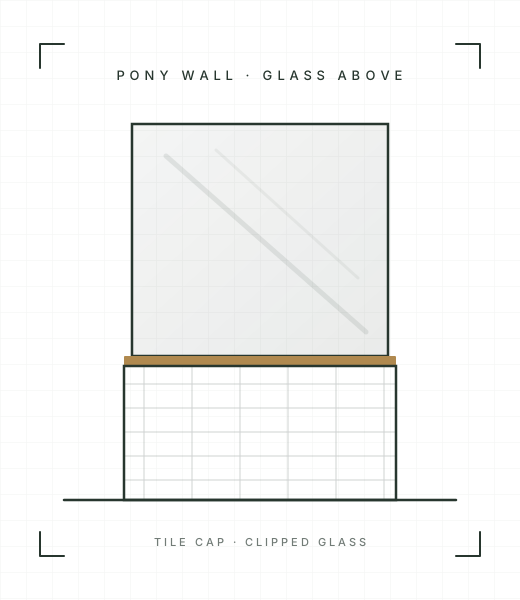
Top-mounted clips
Glass panel anchored to clips set on top of the pony wall — minimal hardware visible from the bathroom side.
Service · Showers
Half-wall and tile-topped configurations for master bath remodels.
Overview
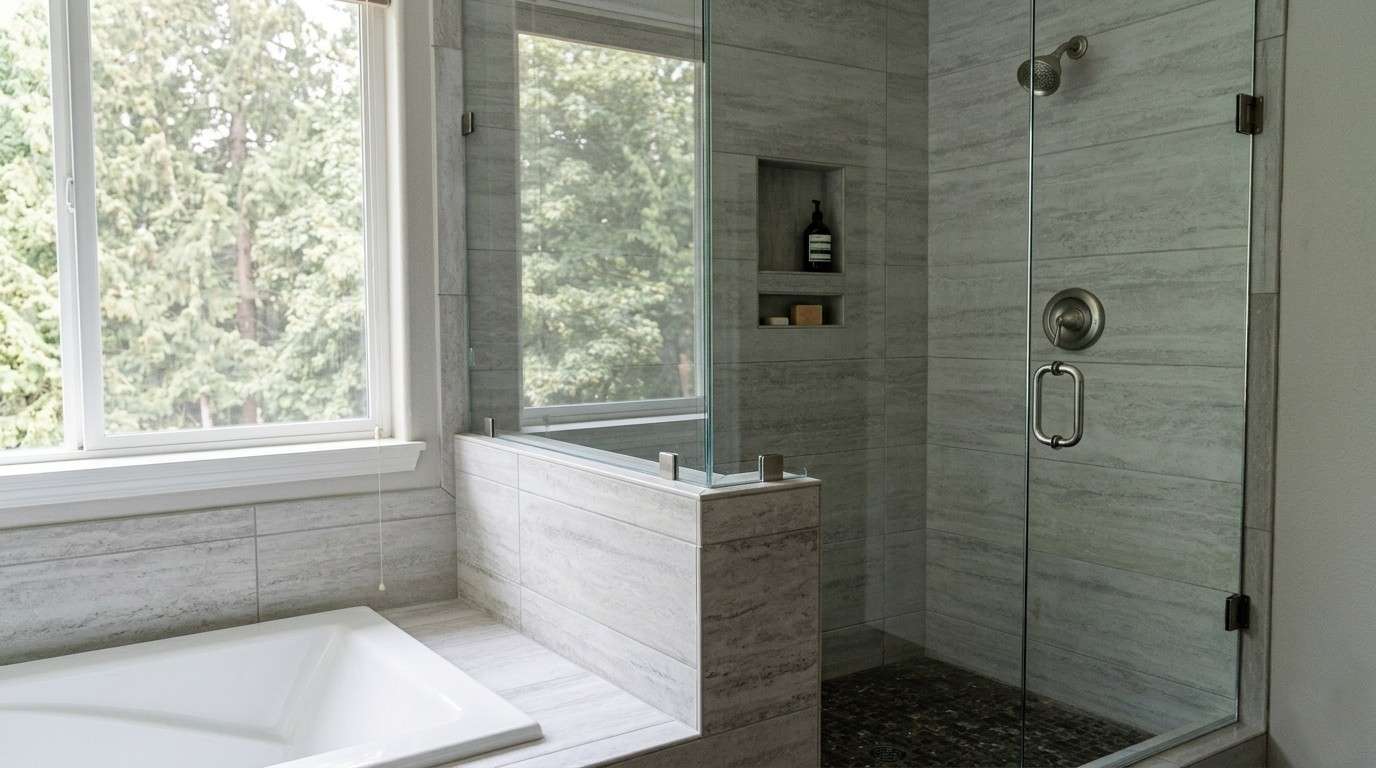
A pony wall (also called a knee wall in bath work) is a short structural wall — typically 36 to 42 inches tall, often capped in tile or stone — with the shower glass continuing above it. It’s one of the most-requested configurations in master bath remodels across Greater Seattle, because it solves two problems at once: it gives the toilet or a bench an enclosing surface and a place to anchor fixtures, while the glass above keeps the room visually open and lets daylight through to the rest of the bathroom.
The detail that makes or breaks a pony-wall install is the cap. The glass doesn’t sit on framing — it sits on a finished tile or stone top, and how the glass meets that cap determines both the look and whether the wall stays dry inside. Tim measures the cap in person, checks that it’s level and that the tile contractor left enough flat bearing surface, and selects the anchoring method based on what the cap is actually made of. A natural-stone cap, a mitered tile cap, and a Schluter-edged cap each take a different approach, and that call can’t be made from a photo.
We see pony-wall glass in three common forms. The first is a single panel clipped to the top of the wall with a hinged or fixed door alongside it — the most common master-bath layout. The second is a panel that runs the length of the wall and returns at 90° into a fixed panel or the tiled wall for a full enclosure. The third is a taller configuration where the glass above a low knee wall runs close to the ceiling; tall glass over a short wall needs 1/2” for stability and benefits from a top-mount or U-channel detail that locks the panel against flex.
Sealing matters more here than on a curb-to-ceiling enclosure. Water that runs down the inside face of the glass has to be directed back into the shower, not into the seam where the glass meets the tile cap — that seam is the most common source of pony-wall leaks years down the line when it’s done by an installer who treats it like a standard sill. We bed the hardware and run the bead so the cap drains inward, and we flag any cap that’s pitched the wrong way before fabrication so your tile contractor can correct it while it’s still easy.
Included
Options
Glass panel anchored to clips set on top of the pony wall — minimal hardware visible from the bathroom side.
Continuous channel along the top of the pony wall accepts the glass; clean linear look.
Glass returns at 90° to a wall or fixed panel for full enclosure.
Glass & finish
Eight glass types, fourteen hardware finishes — picked at the in-home measure.
Glass types
Hardware finishes
FAQ
Plan your project