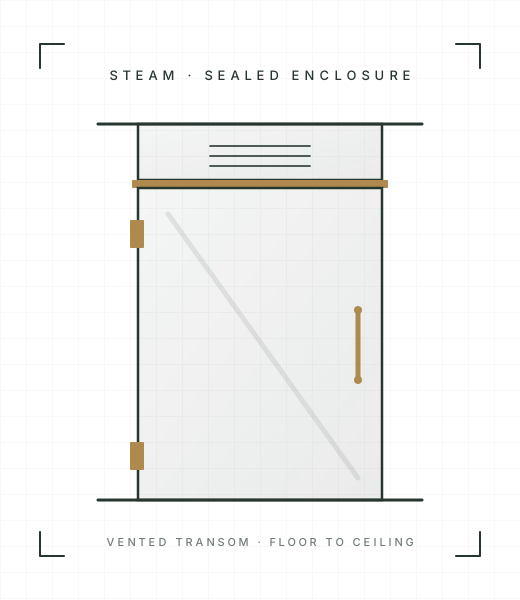
Steam — sealed enclosure
Full perimeter gasket on all four edges plus an upper transom panel that vents heat at the press of a button. Glass is set into a frame that contains steam without trapping it.
Service · Showers
Sealed steam-room doors and dry sauna doors with wood-frame integration.
Overview
Steam and sauna doors look similar in a brochure and are nothing alike to build. A steam enclosure has to hold pressurized vapor inside a sealed box and still let you vent it on command. A sauna door has to survive dry radiant heat and integrate into a wood frame without warping the wood or fogging the glass. Specifying one when you needed the other is an expensive mistake, which is why this is work most general shower-door installers send elsewhere — and why we treat it as its own scope.
A true steam shower is a sealed room, not just a shower with a tall door. The glass runs floor to ceiling, every edge carries a continuous gasket, the door seals on all four sides, and an operable transom panel at the top lets you release heat and steam when the session ends. Get any one of those wrong and the steam either escapes into the bathroom (so the generator never reaches temperature) or has nowhere to go (so the ceiling and the rest of the bath take the moisture). Tim measures the enclosure as a system — head height, transom swing, generator location, and how the ceiling is finished — because all of it affects whether the box actually holds steam.
The configurations we install most are a wall-mounted door-and-transom for a standard alcove, an inline panel-door-panel run for a wider spa enclosure, a corner enclosure with a return panel for tighter footprints, and a pony-wall-mounted steam enclosure where a bench or knee wall sits inside the sealed space. Each one changes how the transom is hung and where the gasket runs; we lay that out at the measure rather than forcing a stock kit onto a custom room.
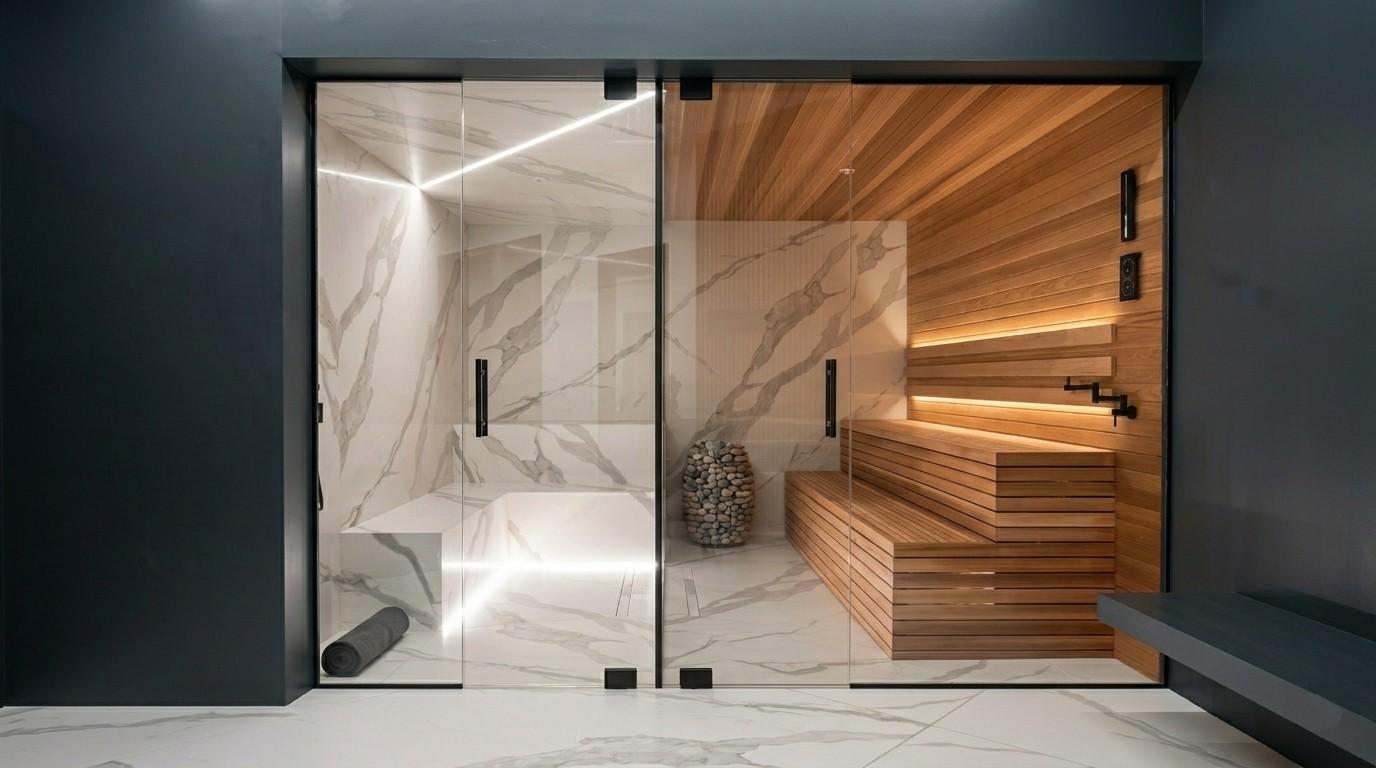
A sauna door is the opposite problem. There’s no gasket and no transom — sauna heat is dry, and the door’s job is to take radiant heat without distorting and to sit cleanly in a wood frame that matches the sauna’s interior species (cedar, hemlock, and abachi are the common ones). The glass is dry-rated; the integration with the millwork is the careful part, because the wood moves with heat and the glass doesn’t, and the frame detail has to absorb that difference. Where a project has a steam shower next to a sauna — common in higher-end primary suites — we coordinate both doors on one hardware schedule so they read as a deliberate pair instead of two unrelated installs.
Included
Options
Full perimeter gasket on all four edges plus an upper transom panel that vents heat at the press of a button. Glass is set into a frame that contains steam without trapping it.
Glass panel set into a wood frame that matches your sauna's interior species (cedar, hemlock, abachi). No gasket — sauna heat is dry.
Some installs run a steam shower next to a sauna; we coordinate both doors so the hardware reads as a set.
Glass & finish
Eight glass types, fourteen hardware finishes — picked at the in-home measure.
Glass types
Hardware finishes
Recent work
FAQ