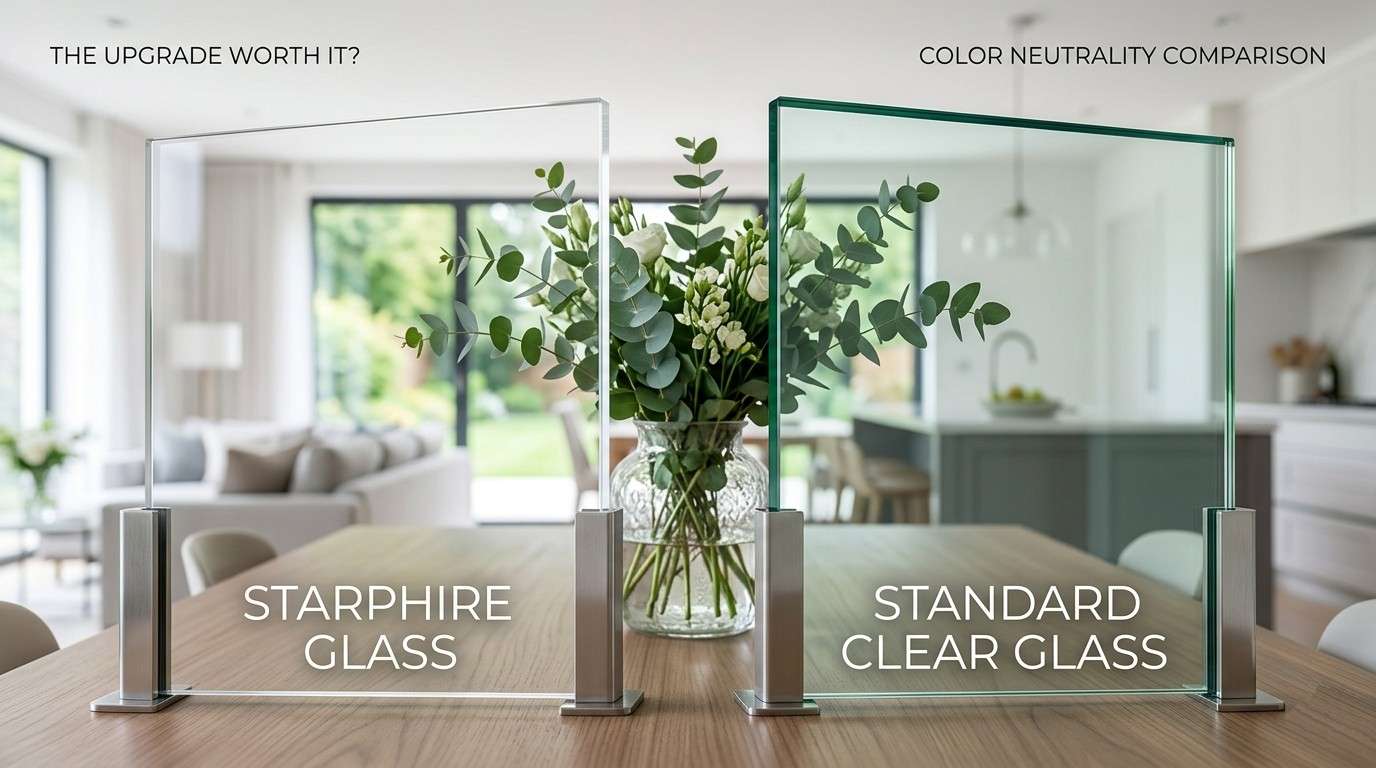
Most people picking glass for a new shower never see the difference between standard clear and low-iron glass until both are sitting in the same room. Then it’s obvious. Standard clear glass has a green tint, especially at the edges. Low-iron glass doesn’t. PPG’s Starphire is the most common premium variant.
Whether that difference matters for your project depends on three things: how big the panels are, how the bathroom is lit, and how much the glass is meant to be a design feature versus a function. Below is what eighteen years of installing both has taught me about when the upgrade is worth it and when it isn’t.
What gives clear glass its green tint
Standard tempered glass is made with a small amount of iron oxide. The iron is part of how the glass is manufactured. It’s what gives clear glass its very slight green tint at the edge of a panel, where you look through the cross-section.
On a thin pane of glass, the tint is almost invisible. On a 3/8-inch shower panel, you can see it on the edges if you look. On a 1/2-inch panel, especially a tall one with long edges visible, the tint becomes a real visual element. Look at the edge of a sliding shower door head-on and you’ll see a soft green band running along the cut.
The tint is also subtly visible through the body of the glass, not only at the edges. In direct natural light or under cool LED, the area behind a standard-clear panel can read very slightly green compared to what’s actually there. White subway tile behind clear glass looks just barely sage. Stone with warm undertones reads slightly muted.
That’s normal for the material, not a defect.
What’s different about Starphire
Starphire is PPG’s brand name for ultra-clear, low-iron tempered glass. The manufacturing process reduces the iron oxide content significantly, which eliminates the green tint. Other low-iron products are on the market, and most quality glass fabricators offer one. They all behave essentially the same.
Side by side with standard clear, low-iron looks like… nothing. It’s the closest glass gets to looking like nothing is there. Edges read true white-gray. The colors of tile and stone behind the panel come through accurately. The shower hardware reads cleanly against it.
In the cabinetry world, this is the difference between standard plywood edges and matched edge-banding. Most people don’t notice until you point it out, and then they can’t unsee it.
When the upgrade is worth it
Three situations where I almost always recommend low-iron glass:
Large openings and tall panels. The bigger the panel, the more edge there is to show the tint, and the more glass body the light passes through. A 6-foot tall, 4-foot wide single panel in standard clear has visible green character. The same panel in Starphire reads neutral. On any heavy-glass installation in 1/2-inch material, low-iron is the right call.
Low-light bathrooms. North-facing bathrooms, basement bathrooms, and any space without strong natural light tend to amplify the green of standard clear because the artificial lighting often skews cool. Low-iron stays neutral under any lighting condition.
Design-first installations. When the shower glass is meant to disappear so the tile, stone, and hardware can carry the design, the tint of standard clear gets in the way. This describes most of what we install in higher-end remodels. The glass is intentionally not the focal point, so it has to read invisibly.
When it isn’t
Some situations where standard clear is the right choice:
Small enclosures with neutral tile. A standard tub-and-shower combo with white tile and chrome hardware looks fine in standard clear. The tint is barely perceptible at this scale, and the budget difference is real.
Hardware-driven design. When bold hardware carries the shower’s design, the eye goes to the hardware rather than the glass. Matte Black and Unlacquered Brass both have that kind of visual presence. The tint of standard clear doesn’t compete in that context.
Dark bathrooms. Bathrooms with deep wall colors, dark stone, or heavily veined materials don’t show the green tint nearly as strongly because there’s less neutral background to compare it against. The tint reads as part of the overall atmosphere.
The cost difference
Low-iron glass typically runs 20 to 35% more than standard clear in shower-panel sizes. The exact delta depends on panel dimensions and the fabricator, but as a planning rule, expect the glass-line item on your quote to go up by roughly that range if you upgrade.
That cost is one-time. The glass is in for the life of the installation.
How we approach it on every project
When we measure for a custom shower or railing, we walk through glass options on-site with samples. Edge views of clear and low-iron held up against the actual tile, stone, and hardware tell you more in two minutes than any showroom can. Most of the time the choice becomes obvious once you see them in the actual space.
The upgrade isn’t always right. But on projects where the glass is meant to read as cleanly as possible, the difference is visible from the first look at the finished install. That describes most of the high-end work we do across Greater Seattle.
If you’re planning a project and want to see the difference in person, we bring both samples to every in-home consultation. Get a free in-home consultation →